支援NFC的設備可以在主動或被動模式下交換數據。在被動模式下,啟動NFC通訊的設備,也稱為NFC發起設備(主設備),在整個通訊過程中提供射頻場(RF-field)。它可以選擇106kbps、212kbps或424kbps其中一種傳輸速度,將數據發送到另一台設備。

另一台設備稱為NFC目標設備(從設備),不必產生射頻場,而使用負載調變(load modulation)技術,即可以相同的速度將數據傳回發起設備。此通訊機制與基於ISO14443A、MIFARE和FeliCa的非接觸式智慧卡相容,因此,NFC發起設備在被動模式下,可以用相同的連接和初始化過程檢測非接觸式智慧卡或NFC目標設備並建立連結。

在主動模式下,每台設備要向另一台設備發送數據時,都必須產生自己的射頻場。發起設備和目標設備都要產生自己的射頻場,以便進行通訊。這是對等網路通訊的標準模式,可以獲得非常快速的連接設定。

[標準化]

NFC是符合ECMA 340與ETSI TS 102 190 V1.1.1以及ISO/IEC 18092標準的一種開放式平台技術。這些標準詳細規定NFC設備的調變方案、編碼、傳輸速度與RF介面的訊框格式,以及主動與被動NFC模式初始化過程中,數據衝突控制所需的初始化方案和條件。此外,這些標準還定義了傳輸協定,其中包括協議啟動和數據交換方法等。

新新手 發表在 痞客邦 留言(0) 人氣()

  • Aug 01 Thu 2013 18:33
  • MIFARE

MIFARE is the NXP Semiconductors-owned trademark of a series of chips widely used in contactless smart cards and proximity cards. According to the producers, billions of smart card chips and many millions of reader modules have been sold.The MIFARE name covers proprietary technologies based upon various levels of the ISO/IEC 14443 Type A 13.56 MHzcontactless smart card standard.

The technology is embodied in both cards and readers (also referred to as a Proximity Coupling Device which is suitable to use).

The MIFARE name (derived from the term MIkron FARE Collection System) covers seven different kinds of contactless cards:

MIFARE Classic 
employ a proprietary protocol compliant to parts (but not all) of ISO/IEC 14443-3 Type A, with an NXP proprietary security protocol for authentication and ciphering.
MIFARE Ultralight
low-cost ICs that employ the same protocol as MIFARE Classic, but without the security part and slightly different commands
MIFARE Ultralight C
the first low-cost ICs for limited-use applications that offer the benefits of an open Triple DES cryptography
MIFARE DESFire
are smart cards that comply to ISO/IEC 14443-4 Type A with a mask-ROM operating system from NXP.
MIFARE DESFire EV1
includes AES encryption.
MIFARE Plus
drop-in replacement for MIFARE Classic with certified security level (AES 128 based)
MIFARE SAM AV2
secure access module that provides the secure storage of cryptographic keys and cryptographic functions

新新手 發表在 痞客邦 留言(0) 人氣()

A contactless smart card is also characterized as follows:

  • Dimensions are normally credit card size. The ID-1 of ISO/IEC 7810 standard defines them as 85.60 × 53.98 × 0.76 mm (3.370 × 2.125 × 0.030 in).[1]

  • Contains a security system with tamper-resistant properties (e.g. a secure cryptoprocessor, secure file system, human-readable features) and is capable of providing security services (e.g. confidentiality of information in the memory).

  • Asset managed by way of a central administration system which interchanges information and configuration settings with the card through the security system. The latter includes card hotlisting, updates for application data.

  • Card data is transferred via radio waves to the central administration system through card reading devices, such as ticket readers, ATMs etc.

新新手 發表在 痞客邦 留言(0) 人氣()

NFC (Near Field Communication) as it is popularly known, is a newer version of RFID based on the ISO 18092 and 14443 HF standards. It operates at a maximum range of about 4 inches (10 centimeters) and can be set up for one- or two-way communications. NFC is similar to passive RFID due to its ability to read and write passive smart tags. But in addition to passive read/write capabilities, NFC has two additional modes, both of which involve dynamic, two-way communication: card emulation and P2P (peer-to-peer). In NFC, both devices may initiate the communication, wherein the initiator always becomes the interrogator. NFC enabled mobile phones are such an example. They can behave like a tag, but also as an interrogator being able to read tags. In such a way they can read tag information and store it on the mobile phone and emulate the tag afterwards.

ISO/IEC 18092 is the base standard for NFC. ISO/IEC 21451 is an extension and as a result NFC supports peer to peer communication, which is the key differentiator between NFC and pure passive RFID, but it also supports reading of smartcards based on ISO/IEC 14443 Type A and Type B, ISO/IEC 15693 and a Japanese industry standard: Felica. The communication range for all variants is typically less than 10 cm.

In addition to the above, NFC solutions have been developed and deployed using UHF passive tags. These tags follow the EPC-Gen2 / ISO 18000-6c standards, but use an antenna design that operates in the near-field like HF tags. These tags may include a dual near-field / far-field antenna, simultaneously offering both good performance around metals and liquids, as well as long-range read performance (> 10 m) on other materials.

新新手 發表在 痞客邦 留言(0) 人氣()


From Wikipedia, the free encyclopedia

Unified Modeling Language (UML) is a standardized (ISO/IEC 19501:2005), general-purpose modeling language in the field of software engineering. The Unified Modeling Language includes a set of graphic notation techniques to create visual models of object-oriented software-intensive systems.

The Unified Modeling Language was developed by Grady BoochIvar Jacobson and James Rumbaugh at Rational Software in the 1990s.[1] It was adopted by the Object Management Group (OMG) in 1997, and has been managed by this organisation ever since. In 2000 the Unified Modeling Language was accepted by the International Organization for Standardization (ISO) as industry standard for modeling software-intensive systems. The current version of the UML is 2.4.1 published by the OMG in August 2011.

Unified Modeling Language (UML) combines techniques from data modeling (entity relationship diagrams), business modeling (work flows), object modeling, and component modeling. It can be used with all processes, throughout the software development life cycle, and across different implementation technologies.[2]

The Unified Modeling Language (UML) offers a standard way to visualize a system's architectural blueprints, including elements such as:

新新手 發表在 痞客邦 留言(0) 人氣()

From Wikipedia, the free encyclopedia

In computing, a hypervisor or virtual machine monitor (VMM) is a piece of computer software, firmware or hardware that creates and runs virtual machines.

A computer on which a hypervisor is running one or more virtual machines is defined as a host machine. Each virtual machine is called a guest machine. The hypervisor presents the guest operating systems with a virtual operating platform and manages the execution of the guest operating systems. Multiple instances of a variety of operating systems may share the virtualized hardware resources.

新新手 發表在 痞客邦 留言(0) 人氣()


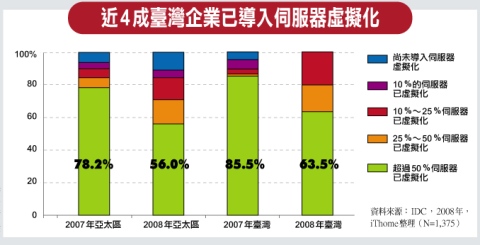
IDC:2011年臺灣虛擬化將超越實體伺服器環境,虛擬化將成市場主流
根據IDC的調查,2007年臺灣企業導入伺服器虛擬化的比例為14.5%,今年則大幅成長達到36.5%,IDC資深分析師暨企業應用召集人曹永暉認為,2011年臺灣企業導入伺服器虛擬化的比例將超過5成。 
曹永暉之所以樂觀看待,主要原因在於伺服器的售價越來越便宜功能越來越強大,曹永暉表示,處理器多核心的發展,讓伺服器的效能越來越強大,如何有效應用伺服器資源就是一門關鍵。 
虛擬化則是有效利用伺服器資源的利器,再加上,虛擬化軟體的成熟與蓬勃,有越來越多的廠商強化伺服器虛擬化的應用,讓虛擬化的穩定度與可用性大幅提高,也強化企業對虛擬化的接受度。 
虛擬化經驗談:儲存配置是重點 

新新手 發表在 痞客邦 留言(0) 人氣()


目前常見的虛擬化技術有那些呢?

1. 全虛擬化 Full Virtualization
2. 半虛擬化 Para-Virtualization
3. 作業系統層虛擬化 OS-Virtualization

有什麼差別

新新手 發表在 痞客邦 留言(0) 人氣()

1
Blog Stats
⚠️

成人內容提醒

本部落格內容僅限年滿十八歲者瀏覽。
若您未滿十八歲,請立即離開。

已滿十八歲者,亦請勿將內容提供給未成年人士。